For any readers who do not know, I am currently a graduate student at Quinnipiac University. I began the journey to obtain my Master’s in the spring of 2018. In 2020 I will be graduating with a degree in Interactive Media and a concentration in User Experience (UX) Design. In the current fall semester, I am taking a Graduate Studies course that has focused on readings that pertain to technology, how it affects society, and its future.
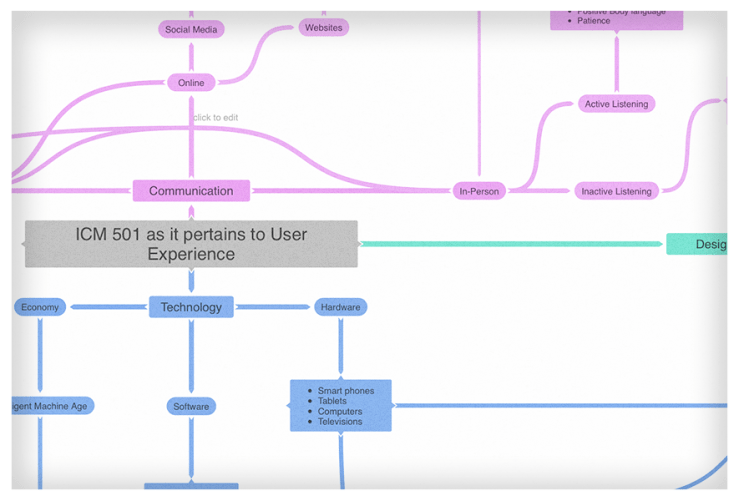
Over the weeks I have come to realize the assortment of students that are in my Graduate Studies classroom. We have graphic designers (Hi!), film students, journalists, and gaming students to name a few. We all work within different media channels, yet we have all ended up in the same classroom. Many times, it is easy for students to look at a course and say things like, “Why am I even taking this class?” However, it is up to us to take what we are learning, reading, and writing about and connect the dots that reveal how this work relates to our future careers. This week, I chose to do this through the creation of a mind map, which can be found by clicking here.
With my course stationed in the middle of my map, I began to think about the general topics that have been covered throughout class, which also have overarching themes in User Experience design. I narrowed these three topics down to Communication, Technology, and Design. Those became the three main branches of my map that led me to think critically about my newly gained knowledge.
Communication
When I began to branch out my map, I started by expanding upon the purpose of all media. That is communication. Over the last 8 or so weeks of class an underlying message about communication has been carried through all of our readings. Through the years there has been a shift in how we interact and communicate with one another. While online communication rises, in-person interactions are seen decreasing, especially in teens. On the positive side, a bridge of communication has been built over the last decade, which keeps more people in contact with distant relatives and friends. For these reasons, and more, it is hard to say whether these new ways of communication are a positive or a negative.
User experience relates to communication the same way the media does. Its purpose is to easily communicate an action to a user as well making it easy for the user themselves to communicate outwardly. Designers have created online features such as the “like” button to help people to send quick and easy communications to one another. In return, designers have also taken that “like” and turned it into a communication between software and the user by creating red notification bubbles.
As a designer you must not take any feature for face value. You also cannot be a designer who invents shallowly. Communication must be a key piece of your ideation.
Technology
As I moved on to the Technology branch of my map I had a good flow going and was easily able to make my connections between my recent learnings of the tech world and UX (aside from the obvious). The most important connection I made was with information I gained early on in the semester about the shift in our economy to the Intelligent Machine Age. The Intelligent Machine Age is a time where workers must surpass jobs that can easily be automated. What can we do as humans that a machine cannot? Or in my case, what can I do as a designer that a computer cannot? Being aware of the economy and the trends in technology helps you to switch your mindset. You must not design for the present, but rather the future. Once you start designing for the future you will guarantee your relevancy in the industry. The further I branch off from my mind maps the more abstract the ideas become. This is where new and inventive concepts are born and the future begins.
Design
Moving on to the most obvious of my three categories, we arrive at Design. This is what brings everything I’ve mentioned previously together. By taking what I have learned about communication and ever-growing technology I am able to understand more clearly how to be a successful UX designer. As a designer, your work heavily affects the success of an app, software, or website. The better the usability means more time spent on an interface, which in return brings better business. The use of algorithms have become extremely popular over the last few years. These innovative algorithm designs have been programmed to better help audiences view content that fits their interests. For example, the explore page on Instagram is a design that brings us continuous content compiled specifically for our needs. This eliminates the hassle of finding it all on our own within the masses. It was a design solution made to help meet the user’s need.
Conclusion
When you start to mind map your work you think deeply. You connect dots that you wouldn’t have at a surface level and start creating new interpretations of the same information. You force your mind into making critical analyses and at the end of it you feel capable. You feel capable of creating innovative work, or in my case, cable of understanding the relevance of information.
If you would like to make a mind map of your own click here and try out Coggle, a free online mapping service,

 Samantha Mantiglia